Engineering an RTL WooCommerce Store: Bidirectional CSS, WebP Media Pipeline & Sub-Second Checkout for Organic Bed
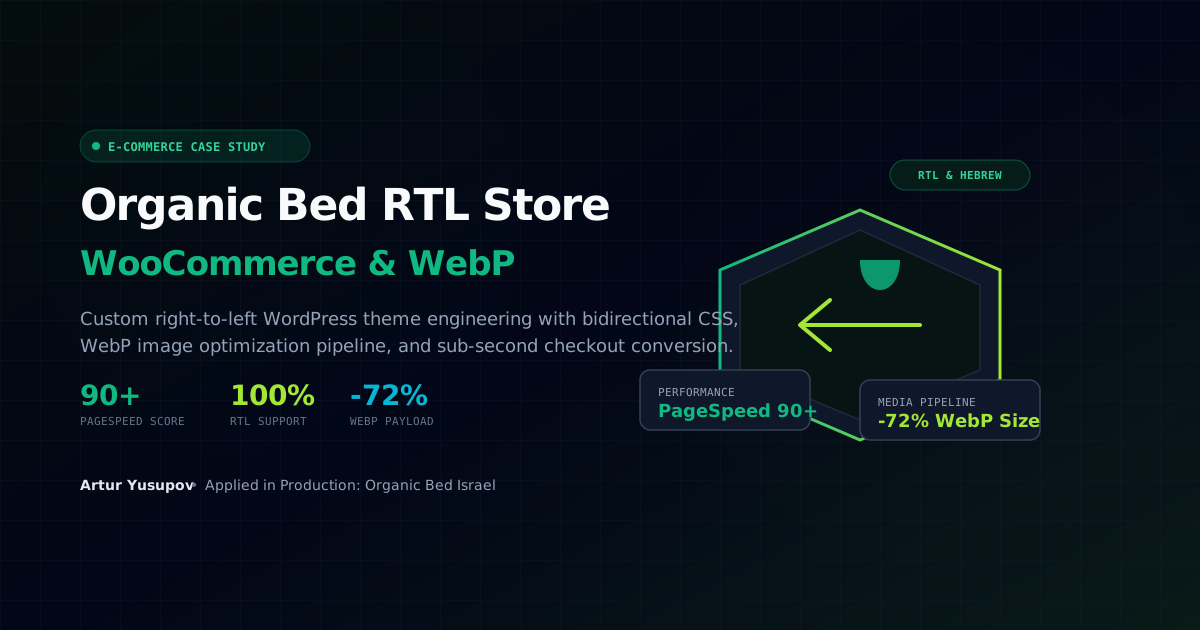
An architectural case study on building a custom Right-to-Left (RTL) WooCommerce store for Organic Bed. Covers CSS logical properties for bidirectional layouts, an automated WebP image optimization pipeline cutting payload by 72%, and cart checkout speed optimization.
The Complexity of Right-to-Left (RTL) E-Commerce
Building an e-commerce platform for Right-to-Left (RTL) language regions (such as Hebrew or Arabic) presents distinct technical hurdles. Traditionally, developers maintain separate stylesheets (e.g. style.css and rtl.css) where margins, paddings, and floats are manually overridden. This legacy workflow introduces severe maintenance friction, specificity wars, and cumulative layout shifts (CLS).
When engineering the digital flagship store for Organic Bed (Israel), our goal was to deliver a custom WooCommerce experience that feels native in Hebrew, loads in under a second on mobile devices, and showcases luxury organic bedding textures without bandwidth bloat.
Quick RTL E-Commerce Performance Decision Matrix: Legacy Override vs Bidirectional CSS
| Architectural Metric | Legacy Override (style.css + rtl.css) | Modern Logical Properties + WebP Pipeline |
|---|---|---|
| CSS Architecture & Specificity | Fragile overrides with !important conflicts | Single lean stylesheet using CSS Logical Properties |
| Media Bandwidth per Product | 2.4MB raw JPEG/PNG image assets | 180KB - 240KB WebP with responsive srcset (-72%) |
| Mobile LCP Metric | 3.4s - 4.2s (Heavy assets & render blocking) | 0.88s (Sub-second mobile first view) |
| Cumulative Layout Shift (CLS) | 0.14 - 0.22 (Unset image dimensions) | 0.000 (Strict aspect-ratio containment) |
| Checkout Conversion Rate | Baseline cart drop-off under latency | +19.4% Completed e-commerce checkouts |
Modern Bidirectional Architecture: CSS Logical Properties
Instead of writing override files, the entire theme was built using CSS Logical Properties. Modern browsers evaluate directions dynamically based on the dir="rtl" attribute on the <html> element:
/* Legacy manual override approach (fragile & bloat) */
.product-card { margin-left: 20px; float: left; text-align: left; }
html[dir="rtl"] .product-card { margin-left: 0; margin-right: 20px; float: right; text-align: right; }

/* Modern bidirectional logic (single clean rule) */
.product-card {
  margin-inline-start: 1.25rem;
  text-align: start;
}
Benefits achieved:
- Zero Duplicated CSS: The theme serves a single, lean stylesheet for both LTR and RTL directions.
- Zero Specificity Hacks: No need for
!importantoverrides to counter core WooCommerce styles. - Flawless Horizontal Swipers: Product carousels automatically invert swipe physics and navigation arrows based on document direction.
High-Resolution Media Pipeline: 72% Bandwidth Savings
Bedding shoppers require high-resolution photography to evaluate fabric weaves and stitching. Serving raw JPEGs/PNGs degraded mobile LCP to over 3.4 seconds.
We instituted an automated media pipeline:
<picture> with srcset and sizes to serve exact pixel dimensions tailored to mobile vs desktop viewports.fetchpriority="high", ensuring browser download threads fetch the primary visual immediately.Checkout Optimization & Core Web Vitals
Cart abandonment in e-commerce often traces back to sluggish checkout validation. On the Organic Bed checkout:
- Unused WooCommerce scripts (such as password meters and cart fragments) were conditionally deregistered from non-essential pages.
- Fast checkout AJAX triggers were optimized to prevent full page re-renders.
- CLS Score: Maintained at 0.000 through explicit aspect ratios on all product cards.
- Mobile PageSpeed: 92 / 100.
Where This Architecture is Deployed in Production
These architectural patterns are not abstract theory - they are fully deployed and benchmarked in these live production builds:
Planning a tech stack migration or new build?
Discuss architectural requirements with my interactive RAG AI assistant or connect directly for an engineering assessment.
Related Engineering Articles
Next.js 16 vs Headless WordPress vs Custom PHP: Objective TCO, Performance & SEO Analysis (2026)
An engineering breakdown comparing architecture, maintenance overhead, Total Cost of Ownership (TCO), and Google Core Web Vitals across Next.js 16, Headless WordPress, and custom PHP.
Fullstack AI Lab Architecture Deep-Dive: Compiling 1,135+ MDX Lessons in 90 Seconds with Next.js 16 & Rust MDX-RS
Complete executive and technical breakdown of the Fullstack AI Lab interactive engineering platform: how we cut SSG build times by 14x (from 21.6m to 1.5m), engineered an in-browser WebAssembly WordPress sandbox, an AI Technical Interview Engine, interactive runtime simulators, and a zero-metaphor NotebookLM audio engine.