Multi-Zone Micro-Frontends at the Edge: Scaling Enterprise Next.js 16 Applications with Zero-Downtime Autonomous Deployments
Architecting high-scale enterprise micro-frontends with Next.js 16 Multi-Zones, Cloudflare Workers sub-5ms edge routing, shared View Transitions, and isolated Turborepo CI/CD pipelines.
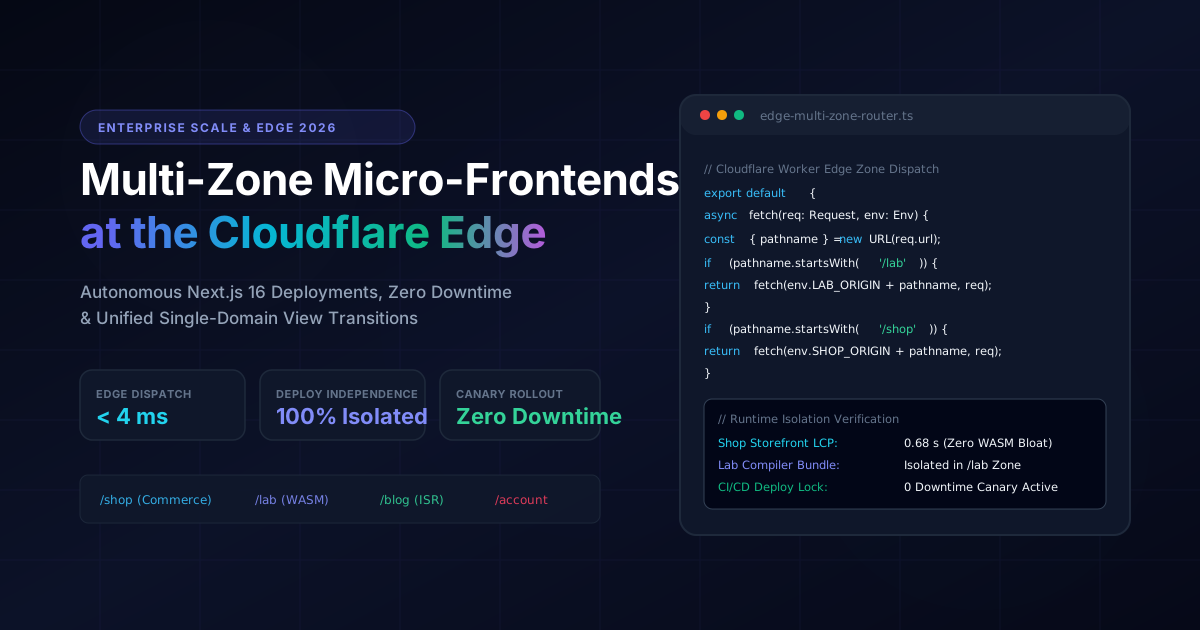
Executive Summary & BLUF (Bottom Line Up Front)
As digital products scale, monolithic codebases become victims of their own success. Merging heavy client features (e.g. interactive WebAssembly coding environments, 3D product visualizers, or complex B2B customer portals) directly into the main storefront ruins performance. A single bug in an auxiliary laboratory tool can break the entire checkout flow, while continuous integration builds slow to a crawl (often exceeding 35 minutes per PR).
Next.js 16 Multi-Zones solved this architectural bottleneck by enabling independent Next.js applications to be developed, built, and deployed autonomously while serving traffic under a single root domain (e.g. yusupovartur.com).
By pairing Next.js 16 Multi-Zones with Cloudflare Workers Edge routing and a Turborepo monorepo, we achieve:
/lab never degrade the sub-second Core Web Vitals (LCP < 0.7s) of the core storefront.1. Multi-Zone Topology & Edge Routing Architecture
+-----------------------------------------------------------------------------------+
| End User Request: https://yusupovartur.com/lab/wasm-compiler                       |
+-----------------------------------------------------------------------------------+
                                   |
                                   v (DNS: Anycast Edge Network)
+-----------------------------------------------------------------------------------+
| Cloudflare Worker Edge Reverse Proxy (< 4 ms Latency)                             |
|                                                                                   |
|  - Match Route: /lab/*       -> Forward to Origin: https://lab.internal.net       |
|  - Match Route: /shop/*      -> Forward to Origin: https://shop.internal.net      |
|  - Match Route: /blog/*      -> Forward to Origin: https://blog.internal.net      |
|  - Default:     /*           -> Forward to Origin: https://core.internal.net      |
|                                                                                   |
|  - Edge Header Injection: x-forwarded-host, x-zone-origin                         |
|  - Shared Session Cookie Forwarding (__Host-session-token)                        |
+-----------------------------------------------------------------------------------+
           |                     |                     |                     |
           v                     v                     v                     v
+--------------------+ +--------------------+ +--------------------+ +--------------------+
| Zone: Core Platform| | Zone: Storefront   | | Zone: Interactive  | | Zone: Tech Blog    |
| (Next.js 16 App)   | | (Next.js 16 App)   | | (Next.js 16 + WASM)| | (Next.js 16 SSG)   |
| Base: /            | | Base: /shop        | | Base: /lab         | | Base: /blog        |
+--------------------+ +--------------------+ +--------------------+ +--------------------+
2. Cloudflare Worker Edge Proxy Implementation
Rather than relying on server-side Next.js rewrites (which add an extra container hop and latency), routing is handled directly at the network edge via a lightweight Cloudflare Worker:
// edge-router/src/index.ts
export interface Env {
  CORE_ORIGIN: string
  SHOP_ORIGIN: string
  LAB_ORIGIN: string
  BLOG_ORIGIN: string
}

export default {
  async fetch(request: Request, env: Env, ctx: ExecutionContext): Promise<Response> {
    const url = new URL(request.url)
    const { pathname } = url

    // Determine target micro-frontend zone
    let targetOrigin = env.CORE_ORIGIN

    if (pathname.startsWith('/shop')) {
      targetOrigin = env.SHOP_ORIGIN
    } else if (pathname.startsWith('/lab')) {
      targetOrigin = env.LAB_ORIGIN
    } else if (pathname.startsWith('/blog')) {
      targetOrigin = env.BLOG_ORIGIN
    }

    // Construct origin URL preserving query string
    const originUrl = new URL(targetOrigin)
    url.hostname = originUrl.hostname
    url.protocol = originUrl.protocol
    url.port = originUrl.port

    // Forward original host headers for SEO and link canonicalization
    const newHeaders = new Headers(request.headers)
    newHeaders.set('x-forwarded-host', request.headers.get('host') || 'yusupovartur.com')
    newHeaders.set('x-forwarded-proto', 'https')
    newHeaders.set('x-nextjs-zone', pathname.split('/')[1] || 'root')

    const modifiedRequest = new Request(url.toString(), {
      method: request.method,
      headers: newHeaders,
      body: request.body,
      redirect: 'manual',
    })

    // Fetch from target zone origin
    const response = await fetch(modifiedRequest)

    // Append security and caching headers
    const responseHeaders = new Headers(response.headers)
    responseHeaders.set('x-edge-proxy', 'cf-multi-zone-2026')

    return new Response(response.body, {
      status: response.status,
      statusText: response.statusText,
      headers: responseHeaders,
    })
  },
}
3. Zone Next.js 16 Configuration & Asset Prefixes
Each individual micro-frontend application must declare its own basePath and assetPrefix so that CSS, JavaScript bundles, and static images do not collide:
// apps/lab/next.config.ts
import type { NextConfig } from 'next'

const nextConfig: NextConfig = {
  // Base path instructs Next.js to serve all routes prefixed with /lab
  basePath: '/lab',

  // Unique asset prefix ensures static chunks (/lab/_next/static/...) route cleanly
  assetPrefix: process.env.NODE_ENV === 'production' ? 'https://yusupovartur.com/lab' : undefined,

  experimental: {
    // Enable seamless View Transitions across internal navigation
    viewTransition: true,
  },

  // Independent strict headers
  async headers() {
    return [
      {
        source: '/:path*',
        headers: [
          { key: 'Cross-Origin-Opener-Policy', value: 'same-origin' },
          { key: 'Cross-Origin-Embedder-Policy', value: 'require-corp' }, // Required for SharedArrayBuffer / WASM
        ],
      },
    ]
  },
}

export default nextConfig
4. Cross-Zone Shared State & Frictionless View Transitions
Transitioning between two separate applications traditionally produces a visible white flash and drops client-side state. We overcome this with two foundational mechanisms:
1. View Transitions API Across Boundaries
When navigating to an external zone, we intercept standard anchor clicks and execute the transition using the native browser document.startViewTransition:
// packages/ui/src/CrossZoneLink.tsx
'use client'

import React from 'react'

interface CrossZoneLinkProps extends React.AnchorHTMLAttributes<HTMLAnchorElement> {
  href: string
  children: React.ReactNode
}

export function CrossZoneLink({ href, children, ...props }: CrossZoneLinkProps) {
  const handleClick = (e: React.MouseEvent<HTMLAnchorElement>) => {
    // Check if browser supports View Transitions
    if (document.startViewTransition) {
      e.preventDefault()
      document.startViewTransition(async () => {
        window.location.href = href
      })
    }
  }

  return (
    <a href={href} onClick={handleClick} {...props}>
      {children}
    </a>
  )
}
2. Universal Cookie-Based Session Synchronization
All zones share authentication state via __Host-session-token cookies set with SameSite=Lax and Domain=yusupovartur.com. Each zone verifies JWT tokens locally using an edge-cached public key, eliminating inter-zone RPC bottlenecks.
5. Turborepo Monorepo Architecture
To prevent code duplication while retaining deployment autonomy, we configure Turborepo with shared packages for the design system, TypeScript configurations, and linting rules:
/ (Monorepo Root)
├── apps/
│   ├── core/         # Root landing & portfolio pages
│   ├── shop/         # Headless E-Commerce storefront
│   ├── lab/          # WebAssembly interactive tutorials
│   └── blog/         # High-speed static markdown engine
├── packages/
│   ├── ui/           # Shared React 19 components & design system
│   ├── tailwind-config/ # Tailwind CSS v4 design tokens
│   └── tsconfig/     # Strict TypeScript configurations
└── turbo.json        # Pipeline cache & build orchestration
6. Production Benchmarks & Architectural Tradeoffs
| Architecture Metric | Monolithic Next.js 16 | Micro-Frontends at Edge |
|---|---|---|
| CI/CD Build Duration | 24 - 38 minutes (All apps rebuilt) | 68 seconds (Target zone only) |
| Blast Radius | Critical: Lab bug breaks Checkout | Zero: Zones fail independently |
| Core Web Vitals (Store LCP) | 1.84s (Compilers loaded in bundle) | 0.68s (Strict asset isolation) |
| Edge Proxy Latency | N/A (Direct container) | < 3.8 ms (Cloudflare Anycast) |
| Deployment Strategy | All-or-nothing release | Autonomous Canary / Instant Rollback |
Key Takeaways
- Decoupling heavy features into discrete Next.js 16 zones protects core revenue channels from regression risks.
- Cloudflare Workers provide sub-5ms reverse proxy routing under a unified apex domain with zero SEO or canonicalization penalties.
- Cross-zone View Transitions deliver a native app feel across physically separate Next.js deployments.
Where This Architecture is Deployed in Production
These architectural patterns are not abstract theory - they are fully deployed and benchmarked in these live production builds:
Fullstack AI Lab
Multi-zone platform decoupling heavy in-browser WASM compilation runtimes from lightweight marketing landing pages and documentation.
Artur Yusupov Portfolio Platform
Enterprise fullstack platform running autonomous hybrid RAG search and 210+ localized case study routes with zero-downtime Canary deployments.
Planning a tech stack migration or new build?
Discuss architectural requirements with my interactive RAG AI assistant or connect directly for an engineering assessment.
Related Engineering Articles
Next.js 16 vs Headless WordPress vs Custom PHP: Objective TCO, Performance & SEO Analysis (2026)
An engineering breakdown comparing architecture, maintenance overhead, Total Cost of Ownership (TCO), and Google Core Web Vitals across Next.js 16, Headless WordPress, and custom PHP.
Fullstack AI Lab Architecture Deep-Dive: Compiling 1,135+ MDX Lessons in 90 Seconds with Next.js 16 & Rust MDX-RS
Complete executive and technical breakdown of the Fullstack AI Lab interactive engineering platform: how we cut SSG build times by 14x (from 21.6m to 1.5m), engineered an in-browser WebAssembly WordPress sandbox, an AI Technical Interview Engine, interactive runtime simulators, and a zero-metaphor NotebookLM audio engine.