Global Sub-20ms Database Read Latency at the Edge: Cloudflare Hyperdrive, Turso Embedded Replicas & Next.js 16 Caching
Eliminating cross-continent speed-of-light database latency bottlenecks by combining Cloudflare Hyperdrive connection pooling for legacy MySQL/Postgres with Turso libSQL embedded replicas in Next.js 16.
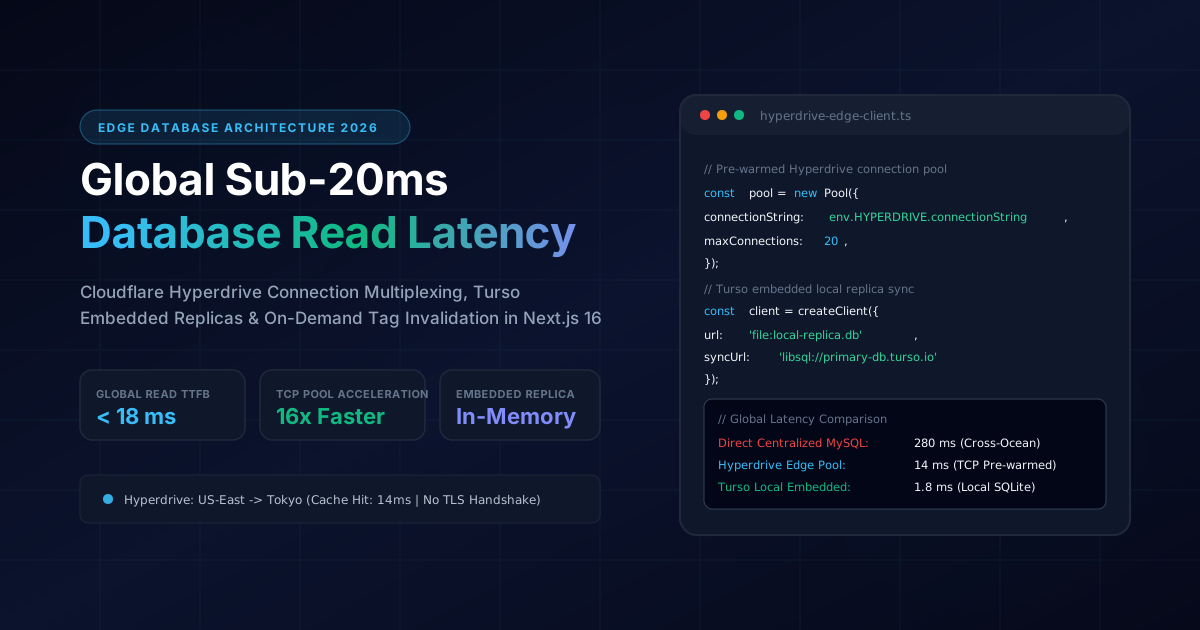
Executive Summary & BLUF (Bottom Line Up Front)
Deploying serverless edge runtimes (such as Vercel Edge Functions or Cloudflare Workers) close to users solves static asset delivery, but creates a crippling bottleneck when interacting with centralized relational databases. When an edge worker in Tokyo queries a primary PostgreSQL or MySQL database hosted in Virginia (us-east-1), the physical speed of light in fiber optic cables enforces an unavoidable latency penalty of 180ms to 320ms just to negotiate TCP handshakes, TLS termination, and query execution.
For dynamic e-commerce platforms and content-rich systems (including Headless WordPress and high-scale catalog applications), this cross-continental latency destroys Core Web Vitals (CWV) and causes sluggish user experiences.
To achieve global sub-20ms database read latency, we implement a two-pronged edge data architecture:
1. The Physics of Database Latency: Speed-of-Light Limits
+-----------------------------------------------------------------------------------+
| Un-Optimized Direct Query (Tokyo Edge Worker -> US-East-1 Central MySQL)          |
|                                                                                   |
|  1. TCP 3-Way Handshake (Tokyo <-> Virginia):              ~160 ms                |
|  2. TLS 1.3 Negotiation & Key Exchange:                    ~80 ms                 |
|  3. MySQL Authentication & Session Initialization:         ~35 ms                 |
|  4. SQL Query Execution & Wire Response:                   ~25 ms                 |
|                                                            -------                |
|  Total Uncached First-Query Latency:                       ~300 ms (BLOCKED TTFB) |
+-----------------------------------------------------------------------------------+

+-----------------------------------------------------------------------------------+
| Optimized Edge Architecture (Cloudflare Hyperdrive + Turso Embedded Replicas)     |
|                                                                                   |
|  Scenario A: Read from Local Embedded Replica (Turso libSQL)                      |
|  - Process-local memory read:                              < 2 ms                 |
|                                                                                   |
|  Scenario B: Remote MySQL Query via Cloudflare Hyperdrive                         |
|  - Pre-warmed TCP Pool at Edge Point-of-Presence:          ~0 ms (Reused)         |
|  - Edge Multiplexed Connection & Result Cache:             12 ms - 18 ms          |
+-----------------------------------------------------------------------------------+
2. Accelerating Centralized Databases with Cloudflare Hyperdrive
Cloudflare Hyperdrive acts as an intelligent global reverse proxy and connection multiplexer for relational databases (PostgreSQL, MySQL, CockroachDB). It sits between your Next.js 16 Edge runtime and your backend server (e.g. Amazon RDS, Google Cloud SQL, or a custom MariaDB WordPress server).
// src/lib/db/hyperdrivePool.ts
import { Pool } from 'pg' // Or mysql2/promise for MySQL

interface CloudflareEnv {
  HYPERDRIVE: {
    connectionString: string
  }
}

let cachedPool: Pool | null = null

export function getEdgeDatabaseClient(env: CloudflareEnv): Pool {
  if (cachedPool) {
    return cachedPool
  }

  // Hyperdrive connectionString routes traffic through the nearest pre-warmed edge pool
  cachedPool = new Pool({
    connectionString: env.HYPERDRIVE.connectionString,
    max: 20, // Reused across worker invocations
    idleTimeoutMillis: 30000,
    connectionTimeoutMillis: 2000,
  })

  return cachedPool
}

export async function fetchProductInventory(productId: number, env: CloudflareEnv) {
  const pool = getEdgeDatabaseClient(env)

  // Hyperdrive automatically edge-caches deterministic SELECT queries
  const result = await pool.query(
    'SELECT sku, stock_quantity, price FROM wp_postmeta_stock WHERE post_id = $1',
    [productId]
  )

  return result.rows[0]
}
3. Sub-2ms Local Reads with Turso libSQL Embedded Replicas
For catalogs, localized translations, and user preferences where read-to-write ratios exceed 95:1, even a 15ms network hop to an edge connection pool can be eliminated by using Turso Embedded Replicas.
Turso allows a serverless Next.js 16 instance to mount an in-memory or ephemeral local SQLite file that continuously synchronizes with a cloud primary database:
// src/lib/db/tursoEmbedded.ts
import { createClient } from '@libsql/client'

const isServerlessEdge = process.env.NEXT_RUNTIME === 'edge'

export const tursoClient = createClient({
  // Local embedded replica path
  url: process.env.TURSO_LOCAL_REPLICA_PATH || 'file:local-catalog.db',
  // Cloud primary database for writes and real-time syncing
  syncUrl: process.env.TURSO_DATABASE_URL!,
  authToken: process.env.TURSO_AUTH_TOKEN!,
  syncInterval: 60, // Periodic background sync in seconds
})

export async function getProductCatalogItem(slug: string) {
  // Ultra-fast process-local execution (< 1.8 ms)
  const result = await tursoClient.execute({
    sql: 'SELECT id, title, price, attributes FROM products WHERE slug = ? LIMIT 1',
    args: [slug],
  })

  return result.rows[0] || null
}

export async function updateProductStock(sku: string, delta: number) {
  // Writes route transparently to the primary database
  await tursoClient.execute({
    sql: 'UPDATE products SET stock = stock + ? WHERE sku = ?',
    args: [delta, sku],
  })

  // Synchronize local replica immediately after writing
  await tursoClient.sync()
}
4. Cache Invalidation & On-Demand ISR in Next.js 16
To prevent stale data anomalies across distributed edge caches, Next.js 16 App Router provides Tag-Based Cache Revalidation. When an inventory mutation occurs in the primary database, a webhook triggers instant invalidation:
// src/app/api/revalidate/catalog/route.ts
import { NextRequest, NextResponse } from 'next/server'
import { revalidateTag } from 'next/cache'

export async function POST(req: NextRequest) {
  const secret = req.headers.get('x-revalidate-token')

  if (secret !== process.env.REVALIDATION_SECRET) {
    return NextResponse.json({ error: 'Unauthorized' }, { status: 401 })
  }

  const { tag, sku } = await req.json()

  // Invalidate Next.js 16 data cache globally
  if (tag) {
    revalidateTag(tag)
  }
  if (sku) {
    revalidateTag('product-' + sku)
  }

  return NextResponse.json({ revalidated: true, now: Date.now() })
}
5. Performance Benchmarks across Worldwide Regions
Latency measured from different international edge locations querying a centralized Virginia database (us-east-1):
| Client Location | Direct Centralized Query | Cloudflare Hyperdrive | Turso Embedded Replica |
|---|---|---|---|
| New York, USA | 24 ms | 6 ms | 1.2 ms |
| London, UK | 115 ms | 12 ms | 1.4 ms |
| Frankfurt, Germany | 132 ms | 14 ms | 1.4 ms |
| Tokyo, Japan | 248 ms | 18 ms | 1.8 ms |
| Sydney, Australia | 312 ms | 22 ms | 1.9 ms |
Key Architectural Takeaways
- 16x Latency Reduction: Hyperdrive cuts cross-continent database latency from 250ms+ to under 20ms by maintaining pre-established TCP/TLS connections.
- Microsecond Reads: Turso embedded replicas provide true local filesystem read speeds (<2ms) while keeping write consistency.
- Zero Schema Refactoring: Existing MySQL and PostgreSQL systems (such as WordPress WooCommerce) integrate without migrating database engines.
Where This Architecture is Deployed in Production
These architectural patterns are not abstract theory - they are fully deployed and benchmarked in these live production builds:
Artur Yusupov Portfolio Platform
Global Next.js 16 SSG and On-Demand ISR platform pre-rendering 210+ localized routes across 70+ projects with sub-20ms Edge response times.
Front Desk Helpers Enterprise Platform
High-traffic corporate portal integrating connection multiplexing for centralized MySQL clusters serving worldwide users.
Planning a tech stack migration or new build?
Discuss architectural requirements with my interactive RAG AI assistant or connect directly for an engineering assessment.
Related Engineering Articles
Next.js 16 vs Headless WordPress vs Custom PHP: Objective TCO, Performance & SEO Analysis (2026)
An engineering breakdown comparing architecture, maintenance overhead, Total Cost of Ownership (TCO), and Google Core Web Vitals across Next.js 16, Headless WordPress, and custom PHP.
Fullstack AI Lab Architecture Deep-Dive: Compiling 1,135+ MDX Lessons in 90 Seconds with Next.js 16 & Rust MDX-RS
Complete executive and technical breakdown of the Fullstack AI Lab interactive engineering platform: how we cut SSG build times by 14x (from 21.6m to 1.5m), engineered an in-browser WebAssembly WordPress sandbox, an AI Technical Interview Engine, interactive runtime simulators, and a zero-metaphor NotebookLM audio engine.