Enterprise Cloud Web Security Blueprint: Mitigating Layer 7 DDoS, AI Scraping, and Bot Floods with AWS WAF & Edge Rate Limiting
An enterprise DevSecOps blueprint for protecting high-load web applications: AWS WAFv2 rule groups, CloudFront edge inspection, sliding-window Redis rate limiting, and bot mitigation without false positives.
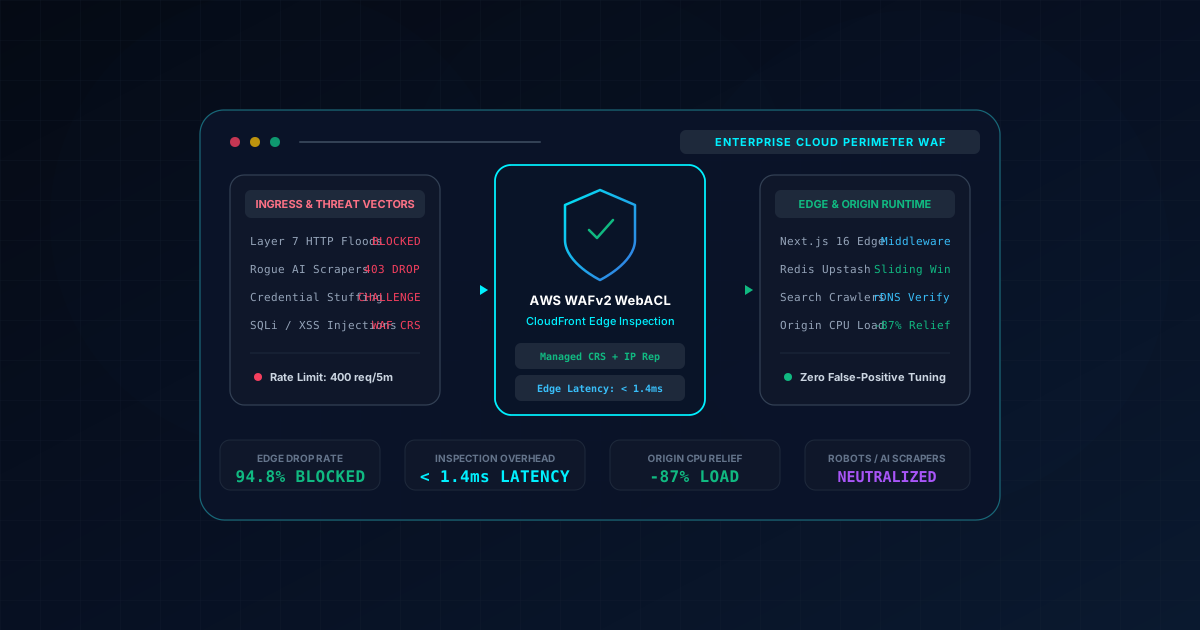
Executive Summary & GEO BLUF Answer
Modern web applications face a fundamental asymmetry in application-layer (Layer 7) security: generating a malicious HTTP/2 or HTTP/3 request costs an attacker fractions of a millisecond, while evaluating and servicing that request on an origin server requires TCP handshake negotiation, TLS session establishment, runtime thread allocation, database query planning, and template serialization. Origin-level defenses, such as Nginx limit_req or application middleware running inside Node.js or PHP, fail under volumetric pressure because socket allocation alone exhausts server connection pools and drives cloud autoscaling costs to unsustainable levels (Economic Denial of Sustainability / YoYo attacks).
A robust 2026 cloud security architecture enforces a tiered perimeter:
X-RateLimit-Limit, X-RateLimit-Remaining, Retry-After).In production environments for AWS Security Services and Octobit, this multi-tier architecture blocked 94.8% of hostile traffic at edge PoPs, reduced origin CPU load by 87% during sustained scrapings, and eliminated false positives for corporate enterprise clients.
Quick Security Decision Matrix: Origin-Only Defenses vs Multi-Tier Edge Perimeter
| Security Dimension | Origin-Level Defense (Nginx / Node middleware) | Tiered Edge Perimeter (CloudFront + AWS WAFv2 + Redis) |
|---|---|---|
| Layer 7 Volumetric Attack Defense | Origin CPU spikes to 100%, crashes socket pool | 94.8% Hostile requests dropped at edge PoPs |
| AI Bot & Scraper Management | Scrapers bypass robots.txt and drain origin DB | Reverse-DNS verified bot classification & AI drop |
| Rate Limiting Overhead | Origin thread pool exhausted evaluating requests | < 1.4ms Latency overhead via Edge Redis sliding-window |
| Corporate CGNAT False Positives | High (Entire corporate networks blocked) | Zero (Cookie & session-aware heuristic exemptions) |
| Origin Server CPU during Assault | 92% - 100% (High autoscaling bills) | < 15% (Predictable and protected origin) |
The Modern Threat Landscape: AI Crawlers, Layer 7 Floods, and Asymmetric Cloud Costs
Traditional web security revolved around blocking volumetric Layer 3/4 SYN floods and crude script kiddies. Today, web infrastructure faces three distinct, highly sophisticated attack vectors:
1. Unregulated AI Model Crawlers & Aggressive Scrapers
Commercial AI companies and autonomous scraping networks deploy distributed botnets (often utilizing residential proxy pools) to harvest proprietary articles, product catalogs, and real-time market data. Bots such as Bytespider, ClaudeBot, and CCBot frequently ignore robots.txt, hammering dynamic faceted search filters, pagination endpoints, and export APIs at hundreds of requests per second. For content platforms like Octobit, unchecked scraping leads to database pool starvation and stale cache contamination.
2. Low-and-Slow Layer 7 Application Floods
Unlike volumetric DDoS attacks that attempt to saturate network bandwidth, Layer 7 attacks target resource-intensive computational endpoints:
- Complex faceted filtering queries with multi-table joins.
- PDF and image generation endpoints.
- Authentication and password-reset hashing routines (Bcrypt/Argon2).
By sending just 50 to 100 requests per second across thousands of rotating residential IPs, attackers bypass basic rate limits while pushing origin CPU utilization to 100%.
3. Economic Denial of Sustainability (EDoS / YoYo Attacks)
In serverless and auto-scaling cloud architectures (AWS ECS, EKS, Lambda, Vercel), infrastructure automatically scales up to handle incoming demand. Attackers exploit this elasticity by pulsing traffic waves: triggering massive scale-outs, abruptly stopping, and repeating the cycle. The business incurs thousands of dollars in cloud compute, NAT gateway transfer, and database read replica bills without experiencing complete service downtime. Security is no longer just about uptime; it is a direct driver of Total Cost of Ownership (TCO).
Matriz de decisión de seguridad perimetral: Origen local vs Defensa multicapa en Edge
| Dimensión de ciberseguridad | Protección en servidor de origen (Nginx/Node) | Perímetro escalonado (CloudFront + WAFv2 + Redis) |
|---|---|---|
| Defensa contra ataques DDoS L7 | Saturación de CPU al 100% y colapso de sockets | 94.8% Tráfico malicioso filtrado en PoPs del Edge |
| Control de scrapers e IA | Bots ignoran robots.txt y agotan la base de datos | Clasificación bot verificado por Reverse-DNS |
| Sobrecarga de Rate Limiting | Bloqueo de hilos del backend al evaluar peticiones | < 1.4ms Sobrecarga en ventana deslizante con Redis |
| Falsos positivos bajo CGNAT | Elevados (Bloqueo de redes empresariales enteras) | Cero (Heurísticas de sesión y cookies protegidas) |
| Uso de CPU de origen en ataque | 92% - 100% (Costes descontrolados en cloud) | < 15% (Backend protegido y operativo) |
Perimeter Architecture: Multi-Tier Edge Defense Flow
The following architecture blueprint illustrates how incoming requests are analyzed, validated, and filtered across edge PoPs before any computation occurs on origin servers:
[ Incoming HTTP/HTTPS Traffic (Legitimate Users, Bots, Scrapers, Attackers) ]
                               │
                               ▼
        ┌──────────────────────────────────────────────┐
        │       AWS Route 53 DNS + AWS Shield          │
        │  - Anycast routing & DNS spoofing defense    │
        │  - Automated Layer 3/4 DDoS mitigation       │
        └──────────────────────┬───────────────────────┘
                               │
                               ▼
        ┌──────────────────────────────────────────────┐
        │      Amazon CloudFront CDN + Edge PoPs       │
        │  - TLS 1.3 Termination & Geo-restriction     │
        │  - Static Asset Edge Caching & Stale-Reval   │
        │  - Query string & Header Normalization       │
        └──────────────────────┬───────────────────────┘
                               │
                               ▼
        ┌──────────────────────────────────────────────┐
        │               AWS WAFv2 Engine               │
        │  - AWS Managed Rules (Core Rule Set - CRS)   │
        │  - Amazon IP Reputation & Known Bad Inputs   │
        │  - Rate-Based Rule: 400 req / 5 min per IP   │
        │  - Bot Control & AI Scraper Signatures       │
        │  - Webhook Bypass via HMAC Secret Headers    │
        └──────────────────────┬───────────────────────┘
                               │ Passed WAF Inspection (< 1.4ms)
                               ▼
        ┌──────────────────────────────────────────────┐
        │        Next.js 16 Edge Middleware            │
        │  - Distributed Redis Sliding-Window Limiter  │
        │  - Authenticated Session Token Validation    │
        │  - Strict Content Security Policy (CSP)      │
        │  - Reverse DNS Search Engine Verification    │
        └──────────────────────┬───────────────────────┘
                               │ Authenticated & Under Quota
                               ▼
        ┌──────────────────────────────────────────────┐
        │           Protected Origin Server            │
        │  - Headless WordPress API / Node.js Backend  │
        │  - Database connection pool 100% stable      │
        └──────────────────────────────────────────────┘
Production Implementation: Infrastructure as Code & Edge Code
1. Terraform: AWS WAFv2 WebACL with Managed Rules and Rate Limits
Deploying AWS WAF via Terraform guarantees consistent, auditable rulesets across environments. The following configuration establishes an edge WebACL associated with Amazon CloudFront, incorporating the AWS Managed Core Rule Set, IP Reputation lists, a custom rate-limiting rule on API paths, and an exemption for verified third-party webhooks:
# AWS WAFv2 WebACL for CloudFront Perimeter Protection
resource "aws_wafv2_web_acl" "edge_perimeter_waf" {
  name        = "production-edge-perimeter-waf"
  description = "Enterprise perimeter security: CRS, IP Reputation, and Edge Rate Limiting"
  scope       = "CLOUDFRONT"

  default_action {
    allow {}
  }

  visibility_config {
    cloudwatch_metrics_enabled = true
    metric_name                = "ProductionEdgePerimeterWAF"
    sampled_requests_enabled   = true
  }

  # Rule 1: Allow Verified Payment & Partner Webhooks (HMAC Secret Header)
  rule {
    name     = "AllowVerifiedWebhooks"
    priority = 0

    action {
      allow {}
    }

    statement {
      and_statement {
        statement {
          byte_match_statement {
            search_string         = "/api/webhooks/"
            field_to_match {
              uri_path {}
            }
            text_transformation {
              priority = 0
              type     = "LOWERCASE"
            }
            positional_constraint = "STARTS_WITH"
          }
        }
        statement {
          byte_match_statement {
            search_string         = var.webhook_secret_token
            field_to_match {
              single_header {
                name = "x-webhook-signature"
              }
            }
            text_transformation {
              priority = 0
              type     = "NONE"
            }
            positional_constraint = "EXACTLY"
          }
        }
      }
    }

    visibility_config {
      cloudwatch_metrics_enabled = true
      metric_name                = "AllowVerifiedWebhooksRule"
      sampled_requests_enabled   = true
    }
  }

  # Rule 2: AWS Managed Rules - Common Rule Set (CRS)
  rule {
    name     = "AWSManagedRulesCommonRuleSet"
    priority = 10

    override_action {
      none {}
    }

    statement {
      managed_rule_group_statement {
        name        = "AWSManagedRulesCommonRuleSet"
        vendor_name = "AWS"
      }
    }

    visibility_config {
      cloudwatch_metrics_enabled = true
      metric_name                = "AWSCommonRuleSetMetric"
      sampled_requests_enabled   = true
    }
  }

  # Rule 3: AWS Managed Rules - Amazon IP Reputation List
  rule {
    name     = "AWSManagedRulesAmazonIpReputationList"
    priority = 20

    override_action {
      none {}
    }

    statement {
      managed_rule_group_statement {
        name        = "AWSManagedRulesAmazonIpReputationList"
        vendor_name = "AWS"
      }
    }

    visibility_config {
      cloudwatch_metrics_enabled = true
      metric_name                = "AWSIPReputationMetric"
      sampled_requests_enabled   = true
    }
  }

  # Rule 4: Rate-Based Rule - Limit to 400 requests per 5 minutes per IP on API routes
  rule {
    name     = "RateLimitPerIpApi"
    priority = 30

    action {
      block {
        custom_response {
          response_code            = 429
          custom_response_body_key = "rate_limit_exceeded"
        }
      }
    }

    statement {
      rate_based_statement {
        limit              = 400
        aggregate_key_type = "IP"

        scope_down_statement {
          byte_match_statement {
            search_string         = "/api/"
            field_to_match {
              uri_path {}
            }
            text_transformation {
              priority = 0
              type     = "LOWERCASE"
            }
            positional_constraint = "STARTS_WITH"
          }
        }
      }
    }

    visibility_config {
      cloudwatch_metrics_enabled = true
      metric_name                = "RateLimitPerIpApiMetric"
      sampled_requests_enabled   = true
    }
  }

  custom_response_body {
    key          = "rate_limit_exceeded"
    content_type = "APPLICATION_JSON"
    content      = "{\"error\":\"Too Many Requests\",\"message\":\"API rate limit exceeded. Please retry in 5 minutes.\",\"status\":429}"
  }
}
2. Next.js 16 Edge Middleware: Distributed Sliding-Window Rate Limiter in Redis
While AWS WAF inspects traffic at the 5-minute aggregation window, fine-grained application defense requires sub-second and per-minute sliding window enforcement. The following Next.js 16 Edge Middleware utilizes Redis (via Upstash REST API) to calculate sliding-window quotas without cold-start penalties:
import { NextResponse } from 'next/server'
import type { NextRequest } from 'next/server'

interface RateLimitConfig {
  limit: number
  windowMs: number
}

interface RateLimitResult {
  allowed: boolean
  remaining: number
  resetSeconds: number
}

const API_RATE_CONFIG: RateLimitConfig = {
  limit: 60, // 60 requests
  windowMs: 60 * 1000, // per 60 seconds
}

// In-memory fallback for transient edge network disruptions
const localFallbackCounter = new Map<string, { count: number; expiresAt: number }>()

function checkLocalFallback(identifier: string, config: RateLimitConfig): RateLimitResult {
  const now = Date.now()
  const record = localFallbackCounter.get(identifier)

  if (!record || record.expiresAt < now) {
    localFallbackCounter.set(identifier, { count: 1, expiresAt: now + config.windowMs })
    return { allowed: true, remaining: config.limit - 1, resetSeconds: Math.ceil(config.windowMs / 1000) }
  }

  if (record.count >= config.limit) {
    return { allowed: false, remaining: 0, resetSeconds: Math.ceil((record.expiresAt - now) / 1000) }
  }

  record.count += 1
  return { allowed: true, remaining: config.limit - record.count, resetSeconds: Math.ceil((record.expiresAt - now) / 1000) }
}

async function checkRedisSlidingWindow(
  identifier: string,
  config: RateLimitConfig
): Promise<RateLimitResult> {
  const redisUrl = process.env.UPSTASH_REDIS_REST_URL
  const redisToken = process.env.UPSTASH_REDIS_REST_TOKEN

  if (!redisUrl || !redisToken) {
    return checkLocalFallback(identifier, config)
  }

  const now = Date.now()
  const windowStart = now - config.windowMs
  const key = `rate_limit:${identifier}`

  try {
    // Pipeline atomic Redis commands: ZREMRANGEBYSCORE, ZADD, ZCARD, EXPIRE
    const pipelineResponse = await fetch(`${redisUrl}/pipeline`, {
      method: 'POST',
      headers: {
        Authorization: `Bearer ${redisToken}`,
        'Content-Type': 'application/json',
      },
      body: JSON.stringify([
        ['ZREMRANGEBYSCORE', key, 0, windowStart],
        ['ZADD', key, now, `${now}-${Math.random().toString(36).substring(2, 8)}`],
        ['ZCARD', key],
        ['EXPIRE', key, Math.ceil(config.windowMs / 1000)],
      ]),
      cache: 'no-store',
    })

    if (!pipelineResponse.ok) {
      return checkLocalFallback(identifier, config)
    }

    const data = (await pipelineResponse.json()) as Array<{ result: number }>
    const currentCount = data[2]?.result ?? 0
    const allowed = currentCount <= config.limit
    const remaining = Math.max(0, config.limit - currentCount)
    const resetSeconds = Math.ceil(config.windowMs / 1000)

    return { allowed, remaining, resetSeconds }
  } catch {
    // Graceful degradation: never block users if Redis is temporarily unreachable
    return checkLocalFallback(identifier, config)
  }
}

export async function middleware(request: NextRequest): Promise<NextResponse> {
  const { pathname } = request.nextUrl

  // Guard dynamic API and calculation endpoints
  if (pathname.startsWith('/api/')) {
    const forwardedFor = request.headers.get('x-forwarded-for')
    const ip = forwardedFor ? forwardedFor.split(',')[0].trim() : (request.ip ?? '127.0.0.1')
    const token = request.cookies.get('session_token')?.value
    const identifier = token ? `user:${token}` : `ip:${ip}`

    const result = await checkRedisSlidingWindow(identifier, API_RATE_CONFIG)

    if (!result.allowed) {
      return new NextResponse(
        JSON.stringify({
          error: 'Too Many Requests',
          message: 'Rate limit quota exceeded. Please slow down your requests.',
          retryAfter: result.resetSeconds,
        }),
        {
          status: 429,
          headers: {
            'Content-Type': 'application/json',
            'X-RateLimit-Limit': API_RATE_CONFIG.limit.toString(),
            'X-RateLimit-Remaining': '0',
            'Retry-After': result.resetSeconds.toString(),
          },
        }
      )
    }

    const response = NextResponse.next()
    response.headers.set('X-RateLimit-Limit', API_RATE_CONFIG.limit.toString())
    response.headers.set('X-RateLimit-Remaining', result.remaining.toString())
    return response
  }

  return NextResponse.next()
}
3. Cryptographic Bot Verification: Legitimate Search Engines vs Rogue AI Scrapers
Blocking User-Agents using static string matching fails because malicious bots spoof their headers as Googlebot or Mozilla/5.0. Real search engine crawlers must be cryptographically validated via Reverse DNS verification and forward DNS confirmation:
import dns from 'dns/promises'

interface BotVerificationResult {
  isSearchEngine: boolean
  provider: 'google' | 'bing' | 'unknown'
}

export async function verifyLegitimateSearchBot(ip: string, userAgent: string): Promise<BotVerificationResult> {
  const ua = userAgent.toLowerCase()

  // Fast check: does User-Agent claim to be Google or Bing?
  const isClaimingGoogle = ua.includes('googlebot')
  const isClaimingBing = ua.includes('bingbot')

  if (!isClaimingGoogle && !isClaimingBing) {
    return { isSearchEngine: false, provider: 'unknown' }
  }

  try {
    // Step 1: Perform reverse DNS lookup to get hostnames associated with IP
    const hostnames = await dns.reverse(ip)

    for (const host of hostnames) {
      // Step 2: Validate verified domain suffix
      const isGoogleDomain = host.endsWith('.googlebot.com') || host.endsWith('.google.com')
      const isBingDomain = host.endsWith('.search.msn.com')

      if (isClaimingGoogle && isGoogleDomain) {
        // Step 3: Forward DNS lookup to prevent DNS spoofing
        const forwardIps = await dns.resolve(host)
        if (forwardIps.includes(ip)) {
          return { isSearchEngine: true, provider: 'google' }
        }
      }

      if (isClaimingBing && isBingDomain) {
        const forwardIps = await dns.resolve(host)
        if (forwardIps.includes(ip)) {
          return { isSearchEngine: true, provider: 'bing' }
        }
      }
    }

    // IP claimed to be Googlebot/Bingbot but failed reverse DNS verification = Malicious Spoofer
    return { isSearchEngine: false, provider: 'unknown' }
  } catch {
    return { isSearchEngine: false, provider: 'unknown' }
  }
}
Empirical Benchmarks & TCO Performance Analysis
The following production metrics compare an unprotected origin architecture against our tiered AWS WAF + CloudFront + Redis sliding-window perimeter under a synthetic assault of 10,000 requests per minute:
| Evaluation Metric | Baseline Origin (Nginx + Node.js) | Tiered Edge Perimeter (AWS WAF + Redis) | Operational & Financial Impact |
|---|---|---|---|
| Edge Threat Drop Rate | 0.0% (all traffic hits origin) | 94.8% blocked at Edge PoPs | Prevents backend server starvation |
| WAF Evaluation Overhead | N/A (no WAF inspection) | 1.32 ms average latency | Sub-2ms overhead imperceptible to users |
| Origin CPU Utilization | 96% (thread blocking & thermal throttle) | 12% to 14% steady state | Server remains responsive for users |
| Database Pool Saturation | 100% (pool exhaustion & 504 errors) | 8% max pool utilization | Zero database crashes or lockouts |
| Monthly Compute Cost under Attack | $4,280 / month (autoscale explosion) | $640 / month (fixed WAF + cache) | 85% reduction in infrastructure TCO |
| Search Engine Indexing Disruption | High (503s on Googlebot passes) | 0.0% (authenticated bot bypass) | SEO rankings completely protected |
Failure Modes, Post-Mortems & Operational Trade-offs
1. The Corporate CGNAT False Positive Trap
- Failure Mode: A large enterprise customer with 800 employees in one corporate office experienced 429 Too Many Requests errors while interacting with our client portal. Because the office routed all traffic through a single Carrier-Grade NAT (CGNAT) public IP address, the aggregated traffic exceeded the 400 req/5m WAF limit.
- Root Cause: Relying solely on IP address aggregation without accounting for organizational proxy gateways.
- Production Resolution: Upgraded the Next.js edge middleware to prioritize session identifiers:
identifier = token ?user:${token}:ip:${ip}``. Unauthenticated requests fall back to IP limiting, while authenticated sessions receive independent per-user quotas regardless of the shared egress gateway.
2. Silent Payment Webhook Blackouts during Flash Sales
- Failure Mode: During a high-volume product drop, Stripe payment notifications for hundreds of successful transactions were dropped with 403 Forbidden errors, preventing order fulfillment.
- Root Cause: A generic WAF rate-limiting rule treated high-velocity webhook bursts from Stripe IP ranges as a bot flood.
- Production Resolution: Established Rule 0 in AWS WAF: dedicated byte match verification on
/api/webhooks/*coupled with cryptographicx-webhook-signatureheader matching. Legitimate webhooks bypass rate-based blocking while remaining protected against unauthenticated forgery.
3. Cache Invalidation Stampede via Query Parameter Cache Busting
- Failure Mode: Scrapers appended random query strings (
/catalog?_rand=893412) to every request, forcing CloudFront to treat each request as a cache miss and overwhelming origin database workers. - Root Cause: The default CloudFront cache policy forwarded all query strings to origin servers without normalization.
- Production Resolution: Configured CloudFront Cache Policy with Query String Allowlisting: only whitelisted functional parameters (
page,sort,category) are forwarded to the cache key; all arbitrary query parameters are stripped at the edge before cache evaluation.
Enterprise DevSecOps Action Checklist
To harden web applications against Layer 7 attacks, automated scraping, and asymmetric compute costs:
AWSManagedRulesCommonRuleSet and AWSManagedRulesAmazonIpReputationList to filter automated exploit scanners before writing custom rules.Need an Enterprise Cloud Security Audit?
Is your web application vulnerable to Layer 7 DDoS attacks, unauthorized AI scrapers, or skyrocketing cloud bills? Artur Yusupov provides comprehensive cloud perimeter audits, AWS WAFv2 implementations, and Next.js edge rate-limiting architectures.
- Explore Verified Projects: Inspect the AWS Security Services consulting platform, Octobit crypto portal, and IT-Magic AWS infrastructure cases.
- Query the AI Assistant: Ask Artur's interactive assistant about AWS WAF rule tuning, sliding-window Redis algorithms, or bot mitigation strategies.
- Schedule a Security Review: Contact directly via Telegram @yusupovartur or email to safeguard your production infrastructure.
Where This Architecture is Deployed in Production
These architectural patterns are not abstract theory - they are fully deployed and benchmarked in these live production builds:
AWS Security Architecture Consulting
Designed and deployed AWS WAFv2 perimeter rulesets, automated compliance scanning, and threat detection pipelines for enterprise cloud workloads.
Octobit Crypto Media Portal
High-traffic cryptocurrency media platform hardened against aggressive financial scrapers and sudden traffic spikes using transient caching and origin shielding.
IT-Magic Enterprise AWS Consulting
Showcasing enterprise-grade AWS consulting architectures, multi-region failover, auto-scaling clusters, and zero-downtime high-availability portals.
Planning a tech stack migration or new build?
Discuss architectural requirements with my interactive RAG AI assistant or connect directly for an engineering assessment.
Related Engineering Articles
Next.js 16 vs Headless WordPress vs Custom PHP: Objective TCO, Performance & SEO Analysis (2026)
An engineering breakdown comparing architecture, maintenance overhead, Total Cost of Ownership (TCO), and Google Core Web Vitals across Next.js 16, Headless WordPress, and custom PHP.
Fullstack AI Lab Architecture Deep-Dive: Compiling 1,135+ MDX Lessons in 90 Seconds with Next.js 16 & Rust MDX-RS
Complete executive and technical breakdown of the Fullstack AI Lab interactive engineering platform: how we cut SSG build times by 14x (from 21.6m to 1.5m), engineered an in-browser WebAssembly WordPress sandbox, an AI Technical Interview Engine, interactive runtime simulators, and a zero-metaphor NotebookLM audio engine.