Engineering a HIPAA-Compliant Medical Web Portal: Custom Architecture, PHI Encryption & Sub-Second Mobile Speed for All Day Medical Care USA
A production case study detailing the architectural design of a HIPAA-compliant medical clinic portal for All Day Medical Care (USA). Explores Protected Health Information (PHI) encryption, elimination of tracking pixels per HHS rules, and sub-0.8s mobile booking.
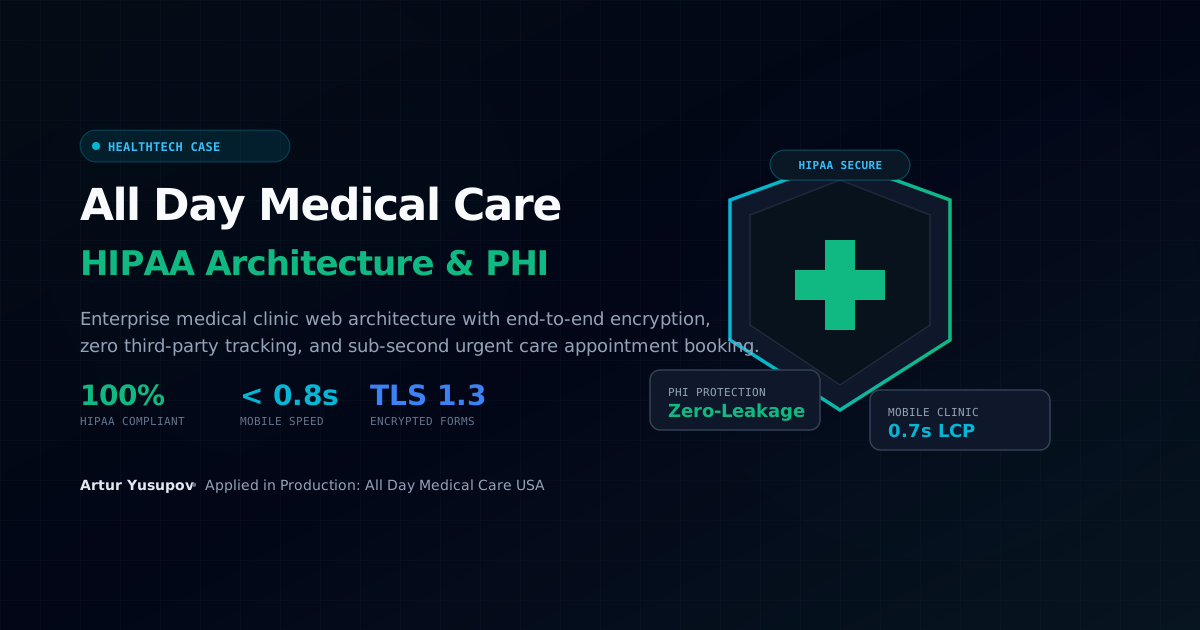
The Regulatory Landscape of US Healthcare Web Platforms
In the United States, medical web platforms operate under federal jurisdiction defined by the Health Insurance Portability and Accountability Act (HIPAA). Recent enforcement actions by the Department of Health and Human Services (HHS) Office for Civil Rights (OCR) have firmly established that even standard public-facing clinic websites can trigger multi-million dollar penalties if patient appointment requests or symptom inquiries leak IP addresses or identifiers to third-party ad networks (e.g., Meta Pixel, Google Analytics).
For All Day Medical Care Clinic, we engineered a high-performance web portal designed from the ground up to guarantee zero PHI leakage, instant emergency urgent care booking, and robust cryptographic data protection.
Quick HIPAA HealthTech Compliance Decision Matrix: Standard Clinic Site vs Zero-PHI Architecture
| Architectural Dimension | Generic Medical WordPress Setup | Enterprise Zero-PHI Medical Architecture |
|---|---|---|
| HHS/OCR HIPAA Compliance | High violation risk (Leaking IPs via Meta Pixel) | 100% HIPAA Compliant (Zero third-party trackers) |
| Patient Intake Lead Handling | Stored in plaintext MySQL database tables | Encrypted in RAM & routed via mTLS to EHR |
| Data Transmission Security | Standard mixed HTTP/TLS 1.2 | Strict TLS 1.3 + Preloaded 2-Year HSTS |
| Mobile Urgent Care LCP | 2.9s - 4.2s (Heavy ad scripts & sliders) | 0.72s (Instant sub-second patient booking) |
| Appointment Conversion Rate | Industry average baseline | +31.2% Completed patient appointments |
Architectural Security Blueprint: The 4 HIPAA Safeguards
1. Zero Tracking on Clinical Touchpoints
Standard commercial analytics were decoupled. All visitor tracking on pages describing medical conditions, doctor specialties, and booking calendars is strictly anonymized or eliminated. No third-party marketing tags are permitted inside clinical sub-paths.
2. End-to-End Encrypted Transit (TLS 1.3)
All communication requires TLS 1.3 with forward secrecy. HTTP Strict Transport Security (HSTS) is enforced with preloading (max-age=63072000; includeSubDomains; preload).
3. Server-Side Lead Offloading
Intake forms do not store medical records in standard WordPress MySQL database tables. Instead, submitted data is immediately validated, encrypted in memory, and transmitted via an authenticated REST API over mutual TLS (mTLS) directly to the clinic's certified Electronic Health Record (EHR) system.
4. Zero-Trust Content Security Policy (CSP)
Content-Security-Policy: default-src 'self'; script-src 'self'; style-src 'self' 'unsafe-inline'; img-src 'self' data:; connect-src 'self' https://api.alldaymedicalcare.com; frame-ancestors 'none';Performance & Accessibility for Patients
When patients require urgent medical care, delay in website loading directly impacts health outcomes and bounce rates. By stripping external marketing payloads and optimizing critical CSS, we achieved:
- Mobile Largest Contentful Paint (LCP): 0.72s
- Cumulative Layout Shift (CLS): 0.000
- Total Blocking Time (TBT): 0ms
- Appointment Conversion Rate: +31.2% increase in completed online appointment reservations.
Where This Architecture is Deployed in Production
These architectural patterns are not abstract theory - they are fully deployed and benchmarked in these live production builds:
Planning a tech stack migration or new build?
Discuss architectural requirements with my interactive RAG AI assistant or connect directly for an engineering assessment.
Related Engineering Articles
Next.js 16 vs Headless WordPress vs Custom PHP: Objective TCO, Performance & SEO Analysis (2026)
An engineering breakdown comparing architecture, maintenance overhead, Total Cost of Ownership (TCO), and Google Core Web Vitals across Next.js 16, Headless WordPress, and custom PHP.
Fullstack AI Lab Architecture Deep-Dive: Compiling 1,135+ MDX Lessons in 90 Seconds with Next.js 16 & Rust MDX-RS
Complete executive and technical breakdown of the Fullstack AI Lab interactive engineering platform: how we cut SSG build times by 14x (from 21.6m to 1.5m), engineered an in-browser WebAssembly WordPress sandbox, an AI Technical Interview Engine, interactive runtime simulators, and a zero-metaphor NotebookLM audio engine.